Have you ever thought about an invention that maybe YOU can't make, but it sure would be nice if someone else did?
One of the things about coming home from Comicon for me is that someone will ask me what it was like or what I saw, and to remember, I inevitably sort of revisit a virtual map of the room in my head, remembering who was in what aisle, what was on which corner, etc. Of course, the squishy organ in my head is limited, and fallible, and so I wish someone would invent an actual street view of Comic-Con.
As most people know, on Google Maps there is a feature called Street View, in which you can see a 360-degree panorama from almost any position on any road in any city. Google accomplishes this by sending out a Street-view car on all of these roads which has an apparatus that takes a photo in every direction, then stitches them all together to make a panorama. The Google apparatus is mounted on top of a car, but what if someone were to make one that sits atop their shoulders or on a backpack or on a hat? That person could walk around the San Diego Comic-Con, New York Comic-Con, C2E2, or Wizard World Anywhere and create an document that would accomplish several goals:
1. A record of what was there that year. How many people did you see and forget? How much of the show did you not have time to explore? What was the new hot thing in 2010 that is utterly forgotten a decade later? Or hey look, it's the next decade's most popular artist as a 22-year old indie creator! How cool would it be to review all of the things the comic show had that year?
2. Promotion of the show. Not everyone goes to a show for the big names that are in the advertising. What if the show has a decent showing of indie creators that are local to the area? What if there are a bunch of booths selling just the sort of thing you're a geek for? What if you have no idea what a comic book convention is like? A chance to quickly check out a show could make the difference to someone on the fence about shelling out the money to go out there.
3. A chance for exhibitors to improve their convention presences. Let's look at the Convention Street View. Oh no, you can't even see me in the sea of people. I need a sign that's at shoulder height or a name tag on the side of my table. Maybe a big sign behind me. Oh wait, that guy did it and it looks terrible! And so forth. It's hard to think about what you really need when you're just scrambling to get all of your stuff on a plane and to the convention hall. Something like this could really focus one's efforts.
A project like this would take time (it's tough to get everywhere in a crowded comic convention), money (cameras aren't free), effort (stitching all the photos together), infrastructure (a map to place this into), and motivation (something beyond it being cool), so it seems like it would either have to be an extremely motivated comic geek, someone on the staff of each convention, or Google itself, or a combination thereof. Perhaps an individual creates the camera-hat and the convention pays him to photograph the show, then Google uses its technology and infrastructure to create the map, linking it from the individual's website and the show's website. Everybody wins!
Especially me, because I never remember what I saw at Comic-Con. I was druh-unk.
So, you want to invent it? Already know about a gadget just like it? Got a reason why it would never work? Got some suggestions? Got your own "I Wish Someone Would Invent..."? See you in the comments!
Showing posts with label I Wish Someone Would Invent. Show all posts
Showing posts with label I Wish Someone Would Invent. Show all posts
Wednesday, July 28, 2010


Monday, May 11, 2009
Just Like Gramps
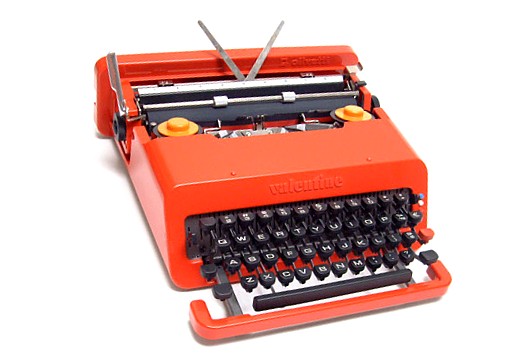
There is nothing better than writing a script using a typewriter font.
Now if someone could write a program that gives my keyboard the loud CLACK CLACK CLACK I'd be set for life.
Wednesday, August 27, 2008
I Wish Someone Would Invent: An Email-to-Fax System
Fax machines are the last holdouts of a previous generation of technology. With email capable of sending higher-resolution pictures faster, with un-garbled text and a searchable and organizable system for telling who it came from, fax machines have been completely left in the dust, capabilities-wise. Why do they hold on? My theory is that the immediateness of the piece of paper printing out of the machine means you can deal with it in the real world, instead (if it's not your thing) of being on the computer, dinking around with computer things. That makes sense for places like Auto Repair Garages or something like that. It's standardized. So I get it.
But if you start a new business today, no matter how tech-savvy you are, you have to buy a fax machine or have ready access to one so that you can send the one fax a month that has to get to some caveman at a tax office somewhere THIS AFTERNOON. I hate that.
So what I propose is that someone, somewhere, create an email code or relay of some sort so that you could send an email to (for instance) 6125551234@email2fax.com, and have that automatically send your text, with any accompanying images, to the fax number (612) 555-1234. Maybe you have to send jpegs of only a certain pixel dimension, maybe you need a specific standardized template so that it'll go to every fax machine, but something, anything, so that I don't have to use our crappy, temperamental 3-in-one to fax, or receive a fax, ever again.
UPDATE: INVENTED!
Whoops, that's got to be a record. Dan Olson points me to this site where there are so many fax-to-email-to-fax programs that I shan't even attempt to list them.
But if you start a new business today, no matter how tech-savvy you are, you have to buy a fax machine or have ready access to one so that you can send the one fax a month that has to get to some caveman at a tax office somewhere THIS AFTERNOON. I hate that.
So what I propose is that someone, somewhere, create an email code or relay of some sort so that you could send an email to (for instance) 6125551234@email2fax.com, and have that automatically send your text, with any accompanying images, to the fax number (612) 555-1234. Maybe you have to send jpegs of only a certain pixel dimension, maybe you need a specific standardized template so that it'll go to every fax machine, but something, anything, so that I don't have to use our crappy, temperamental 3-in-one to fax, or receive a fax, ever again.
UPDATE: INVENTED!
Whoops, that's got to be a record. Dan Olson points me to this site where there are so many fax-to-email-to-fax programs that I shan't even attempt to list them.
Friday, August 08, 2008
I Wish Someone Would Invent: "The Act" for Consoles
Have you ever thought about an invention that maybe YOU can't make, but it sure would be nice if someone else did?
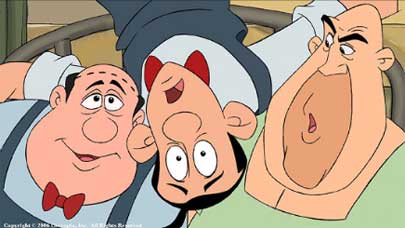
I stumbled recently on a site that spoke about an extremely ambitious project by a video game company named Cecropia. Their game, intended to be a bar arcade game, is called The Act, and is a Dragon's Lair-style 2-D animated narrative, controlled not by joystick and buttons, but by a single knob, which simply raises or lowers the intensity of your character's reactions to whatever's happening. Well, not surprisingly, a non-standard, dialogue-heavy, non-golf arcade game in bars (in which a perfect game takes an hour and one could theoretically spend twenty hours solving it) did not test well and plans for a widespread arcade release were scrapped.

Arcade units are apparently out there and available, and there seem to be whispers of plans for this game to come to PCs, but I want this to come out on Xbox Live Arcade.
I loved Dragon's Lair as a kid, and I was fascinated with the idea of "controlling" an animated sequence. I mean, you only choose either the right or wrong decision, and either live or die, but there was something that made it even more thrilling than an animated movie. So let's move it, Cecropia! I'd buy this in an instant on Live Arcade!
So, you want to invent it? Already know about something just like it? Got a reason why it would never work? Got some suggestions? Got your own "I Wish Someone Would Invent..."? See you in the comments!
I stumbled recently on a site that spoke about an extremely ambitious project by a video game company named Cecropia. Their game, intended to be a bar arcade game, is called The Act, and is a Dragon's Lair-style 2-D animated narrative, controlled not by joystick and buttons, but by a single knob, which simply raises or lowers the intensity of your character's reactions to whatever's happening. Well, not surprisingly, a non-standard, dialogue-heavy, non-golf arcade game in bars (in which a perfect game takes an hour and one could theoretically spend twenty hours solving it) did not test well and plans for a widespread arcade release were scrapped.
Arcade units are apparently out there and available, and there seem to be whispers of plans for this game to come to PCs, but I want this to come out on Xbox Live Arcade.
I loved Dragon's Lair as a kid, and I was fascinated with the idea of "controlling" an animated sequence. I mean, you only choose either the right or wrong decision, and either live or die, but there was something that made it even more thrilling than an animated movie. So let's move it, Cecropia! I'd buy this in an instant on Live Arcade!
So, you want to invent it? Already know about something just like it? Got a reason why it would never work? Got some suggestions? Got your own "I Wish Someone Would Invent..."? See you in the comments!
Monday, August 04, 2008
BTA Games: Classic Rock Bingo
Going on a long car trip? Working late on a project? Hanging around with some friends? Let's play some Classic Rock Bingo!
Requirements:
1. pencil and paper (or better yet, chalk- or whiteboard)
2. a local classic rock station (here in the Twin Cities, 92.5 KQRS)
3. three or more people who can stand to listen to classic rock radio
4. something else to do while this goes on
Rules:
Take turns selecting one band you think will be played in the course of the game. Go around until everyone has selected 4 or 5 bands. These are your bands to listen for. If they are all played before everyone else's, you win!
Wild Card: After everyone chooses their bands, each person must choose one song, by a band that hasn't been named, to be their wild card. If this song is played, you win and the game starts over.
This becomes trickier on a road trip, going in and out of radio range, but I guarantee you this: there isn't a classic-rock dead zone in the United States until you get halfway to Hawaii.
Sample:
Kevin: Bob Seger, The Rolling Stones, ZZ Top, The Doors
Bonus Track: "Lido Shuffle" by Boz Scaggs
Zander: Led Zeppelin, Bachman Turner Overdrive, Deep Purple, Cream
Bonus Track: "Aqualung" by Jethro Tull
Tim: The Who, David Bowie, Bob Dylan, Steve Miller Band
Bonus Track: "Lucky Man" by Emerson, Lake, and Palmer
Requirements:
1. pencil and paper (or better yet, chalk- or whiteboard)
2. a local classic rock station (here in the Twin Cities, 92.5 KQRS)
3. three or more people who can stand to listen to classic rock radio
4. something else to do while this goes on
Rules:
Take turns selecting one band you think will be played in the course of the game. Go around until everyone has selected 4 or 5 bands. These are your bands to listen for. If they are all played before everyone else's, you win!
Wild Card: After everyone chooses their bands, each person must choose one song, by a band that hasn't been named, to be their wild card. If this song is played, you win and the game starts over.
This becomes trickier on a road trip, going in and out of radio range, but I guarantee you this: there isn't a classic-rock dead zone in the United States until you get halfway to Hawaii.
Sample:
Kevin: Bob Seger, The Rolling Stones, ZZ Top, The Doors
Bonus Track: "Lido Shuffle" by Boz Scaggs
Zander: Led Zeppelin, Bachman Turner Overdrive, Deep Purple, Cream
Bonus Track: "Aqualung" by Jethro Tull
Tim: The Who, David Bowie, Bob Dylan, Steve Miller Band
Bonus Track: "Lucky Man" by Emerson, Lake, and Palmer
Wednesday, April 16, 2008
I Wish Someone Would Invent: The Coffee Roomba
Have an IWSWI idea? Send a description and drawing to info [at] bigtimeattic.com, and include "IWSWI" in the subject line.
The Coffee Roomba

Reader David Bernardy from Chapel Hill writes:
Thanks, David!
Reader David Bernardy from Chapel Hill writes:
I like coffee in bed a lot, but not as much as my wife.
The PROBLEM--whose gonna get out of bed to get it.
I think you know the answer to this. Why would I want to invent such a thing if I had a coffee-bearing spouse?
So, the INVENTION, which would allow us both to be happily bedded and caffeinated, goes like this.
Combine the moving-about qualities of a Roomba, with the Timed-Ahead qualiteis of your average automated coffee pot. At a preset time, it could roll into your room, announce itself in a whistle or two, and then shoosh out a couple lattes, or green tea, if that's your preference, or even cocoa. I can imagine add-ons/upgrades that would allow for a bagel toaster and a cream-cheese drawer, but let's not get ahead of ourselves.
COULD THEY DO IT?
Hell, yes. They already have stuff like this: lil' droid butlers that scurry around with cocktail trays on their heads. All I want is one to come to my bed, in the morning, with the hot beverage of my choice, and sing sweet-morning lullabyes to me. Is that too much to ask?
Thanks, David!
Wednesday, May 02, 2007
I Wish Someone Would Invent: Piano Piano Revolution
Have you ever thought about an invention that maybe YOU can't make, but it sure would be nice if someone else did?
All the rhythm video games that are out these days are pretty cool. Dancing ones, guitar ones, drumming ones, singing ones, kids' ones, even taiko and shamisen ones! Of course, the limitations of the interfaces for these games keep most of them from being too useful for learning how to actually play the instrument; the guitar one might increase your manual dexterity, but it wouldn't teach you to play guitar, exactly.

Now, I wish someone would invent Piano Piano Revolution. Particularly a piano game that would actually allow you to actually learn to play piano using it.
In Piano Piano Revolution, you could choose from a very wide range of skill levels (as a great number of people would be extremely advanced), then select whether you'd like to read from traditional sheet music or a more "Guitar Hero"-style visual interface.
Just like all the other rhythm games, there would be multipliers, bonuses, percentage checkpoints, and all other such scorekeeping. Probably a lot of cool virtual pyrotechnics.
Another cool thing about this game would be that since you could use already-existing keyboards, you could make this as a flash game for computers over a long weekend. So get to it, computer geniuses! I want this game!
UPDATE: INVENTED!
Nicholas Piegdon has created Synthesia, a piano rhythm game that has every single aspect I mentioned (sheet music interface coming with next update) and playable on PC and Mac with any USB compatible synthesizer! It's amazing! And free! Way to go, Nicholas!
Check it out at www.synthesiagame.com
So, you want to invent it? Already know about something just like it? Got a reason why it would never work? Got some suggestions? Got your own "I Wish Someone Would Invent..."? See you in the comments!
All the rhythm video games that are out these days are pretty cool. Dancing ones, guitar ones, drumming ones, singing ones, kids' ones, even taiko and shamisen ones! Of course, the limitations of the interfaces for these games keep most of them from being too useful for learning how to actually play the instrument; the guitar one might increase your manual dexterity, but it wouldn't teach you to play guitar, exactly.
Now, I wish someone would invent Piano Piano Revolution. Particularly a piano game that would actually allow you to actually learn to play piano using it.
In Piano Piano Revolution, you could choose from a very wide range of skill levels (as a great number of people would be extremely advanced), then select whether you'd like to read from traditional sheet music or a more "Guitar Hero"-style visual interface.
Just like all the other rhythm games, there would be multipliers, bonuses, percentage checkpoints, and all other such scorekeeping. Probably a lot of cool virtual pyrotechnics.
Another cool thing about this game would be that since you could use already-existing keyboards, you could make this as a flash game for computers over a long weekend. So get to it, computer geniuses! I want this game!
UPDATE: INVENTED!
Nicholas Piegdon has created Synthesia, a piano rhythm game that has every single aspect I mentioned (sheet music interface coming with next update) and playable on PC and Mac with any USB compatible synthesizer! It's amazing! And free! Way to go, Nicholas!
Check it out at www.synthesiagame.com
So, you want to invent it? Already know about something just like it? Got a reason why it would never work? Got some suggestions? Got your own "I Wish Someone Would Invent..."? See you in the comments!
Wednesday, April 25, 2007
I Wish Someone Would Invent: An All-Book MPR Station
I am fortunate to live in the great state of Minnesota, which boasts the best public radio system in the country. For you out-of-towners, Minnesota Public Radio (MPR) is a three-headed [loveable] beast: 91.1 KNOW is non-stop news and information (except for Saturday night, which is a newsless black hole of Prairie Home Companion and jazz), 99.5 KSJN plays classical music and broadcasts the Met opera every Saturday afternoon, and 89.3 the Current is like listening to your cool friend's iPod.
As a cartoonist, I cannot express how grateful I am to these stations for existing, as they provide a hands-free soundtrack to my life while I work. However, they've spoiled me, and the spoiled child always wants more. When I was in high school, I used to tune in Sunday nights to 91.1 because they'd air book readings and short stories, which I found extraordinarily relaxing. Way back then I began dreaming of another MPR station, one that would play 24 hours of people reading stuff. I know that books on tape exist, but I'd honestly much rather make someone else do the work of picking out and airing the readings. Plus, books on tape are so limited compared to the possibilities of a public radio station dedicated to reading: live poetry slams, authors reading their short stories, old scratchy recordings of Dylan Thomas and T. S. Eliot, ... etc.
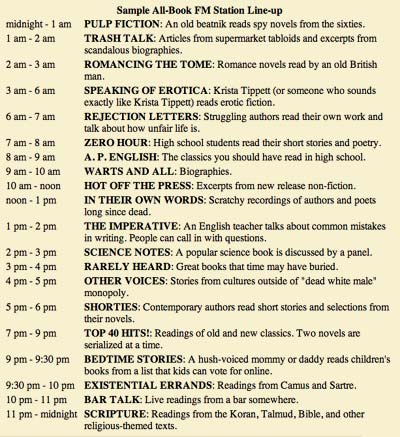
I can't imagine that anything like this station would be able to get off the ground, but it's fun to think about. Here's my imaginary line-up for a typical weekday:
And of course, Garrison Keillor would pop in a few times a day to give us an update on authors' birthdays and remind us how important it is to turn the radio off once in a while and actually go to a library or bookstore.
As a cartoonist, I cannot express how grateful I am to these stations for existing, as they provide a hands-free soundtrack to my life while I work. However, they've spoiled me, and the spoiled child always wants more. When I was in high school, I used to tune in Sunday nights to 91.1 because they'd air book readings and short stories, which I found extraordinarily relaxing. Way back then I began dreaming of another MPR station, one that would play 24 hours of people reading stuff. I know that books on tape exist, but I'd honestly much rather make someone else do the work of picking out and airing the readings. Plus, books on tape are so limited compared to the possibilities of a public radio station dedicated to reading: live poetry slams, authors reading their short stories, old scratchy recordings of Dylan Thomas and T. S. Eliot, ... etc.
I can't imagine that anything like this station would be able to get off the ground, but it's fun to think about. Here's my imaginary line-up for a typical weekday:
And of course, Garrison Keillor would pop in a few times a day to give us an update on authors' birthdays and remind us how important it is to turn the radio off once in a while and actually go to a library or bookstore.
Wednesday, April 04, 2007
I Wish Someone Would Invent: A Cleanable Keyboard
Have you ever thought about an invention that maybe YOU can't make, but it sure would be nice if someone else did?
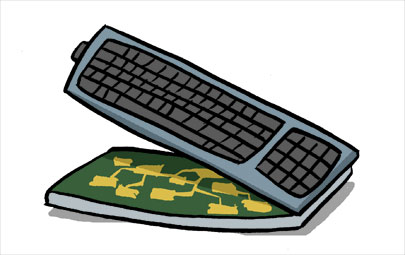
I wish someone would invent a keyboard that you could easily unlatch and open up, wipe off all the dust, dead skin, muffin crumbs, Mountain Dew, and microbes, and then close it up, nice and easy. You wouldn't have to take out all of the keys, or crack open any warranty-voiding seals, just open, wipe, close.
I'm sure you'd have to make sure there was an effective connection between the physical keys and the corresponding circuits that went across the flat barrier. Undoubtedly that would be a little more tricky than the way most keyboards are made now, but I'm sure there are companies that have cleanliness needs that are more extreme than mine and they could come up with something.
So, you want to invent it? Already know about something just like it? Got a reason why it would never work? Got some suggestions? Got your own "I Wish Someone Would Invent..."? See you in the comments!
I wish someone would invent a keyboard that you could easily unlatch and open up, wipe off all the dust, dead skin, muffin crumbs, Mountain Dew, and microbes, and then close it up, nice and easy. You wouldn't have to take out all of the keys, or crack open any warranty-voiding seals, just open, wipe, close.
I'm sure you'd have to make sure there was an effective connection between the physical keys and the corresponding circuits that went across the flat barrier. Undoubtedly that would be a little more tricky than the way most keyboards are made now, but I'm sure there are companies that have cleanliness needs that are more extreme than mine and they could come up with something.
So, you want to invent it? Already know about something just like it? Got a reason why it would never work? Got some suggestions? Got your own "I Wish Someone Would Invent..."? See you in the comments!
Wednesday, March 28, 2007
Wednesday, March 21, 2007
I Wish Someone Would Invent: An ingredients-based recipe website
Have you ever thought about an invention that maybe YOU can't make, but it sure would be nice if someone else did?
Right now I'm going through an "Eat Everything in My Cupboards and Freezer" phase to save a little money and use up some perfectly good food before it goes bad. The problem is when I get down to the homestretch and I'm left with a can of cream of mushroom soup, ketchup, maple syrup, and these crispy dried onion things (I think they're some kind of casserole topping). I know that all of these things are edible, but I'm not smart enough in the kitchen to make a good meal out of 'em.
I wish someone would invent an online database where you can enter the ingredients in your kitchen and it will spit out a bunch of recipes. Over time, I could see it turning into a YouTube-like site, where users can submit their own recipes. Also, like YouTube, users can give each meal a rating and you can read strings of comments. Photos of the final product could accompany the recipe, as well as videos of preparation.
But all that community and human interaction stuff is extra in my opinion. I'd really just like a site that tells me: "You've got tuna, hot peppers, half an onion and some soy sauce? Mix them up this way and heat them this way for this many minutes."
And hey, I've done no internet research on this idea, so if it exists already and you've used it, please let me know! (Before dinner tonight, preferably.)
So, you want to invent it? Already know about something just like it? Got a reason why it would never work? Got some suggestions? Got your own "I Wish Someone Would Invent..."? See you in the comments!
Right now I'm going through an "Eat Everything in My Cupboards and Freezer" phase to save a little money and use up some perfectly good food before it goes bad. The problem is when I get down to the homestretch and I'm left with a can of cream of mushroom soup, ketchup, maple syrup, and these crispy dried onion things (I think they're some kind of casserole topping). I know that all of these things are edible, but I'm not smart enough in the kitchen to make a good meal out of 'em.
I wish someone would invent an online database where you can enter the ingredients in your kitchen and it will spit out a bunch of recipes. Over time, I could see it turning into a YouTube-like site, where users can submit their own recipes. Also, like YouTube, users can give each meal a rating and you can read strings of comments. Photos of the final product could accompany the recipe, as well as videos of preparation.
But all that community and human interaction stuff is extra in my opinion. I'd really just like a site that tells me: "You've got tuna, hot peppers, half an onion and some soy sauce? Mix them up this way and heat them this way for this many minutes."
And hey, I've done no internet research on this idea, so if it exists already and you've used it, please let me know! (Before dinner tonight, preferably.)
So, you want to invent it? Already know about something just like it? Got a reason why it would never work? Got some suggestions? Got your own "I Wish Someone Would Invent..."? See you in the comments!
Wednesday, March 14, 2007
I Wish Someone Would Invent: A Desk-Size Tablet
Have you ever thought about an invention that maybe YOU can't make, but it sure would be nice if someone else did?
This is more about technology than about no one thinking about it, but I wish someone would invent a floppy pressure-sensitive sheet that could roll out on a drafting table and input drawings into a computer. Like the Wacom tablet, it would be a simple way to draw directly into a computer program, and skip the scanning step.

In this case, the tablet would be (obviously) much larger than the 4x6 to 9x12 area that most reasonably-priced tablets offer, and allow the artist to be more expressive with his or her arm movements.
Now, in the wake of the Cintiq tablets (large rotatable monitors that you can draw on with pressure-sensitive pens), there's the thought of making a sheet like the one above that doubles as a monitor as well. I'm sure people would make it if they could-- I can't imagine a graphic artist that wouldn't at least want to check it out.
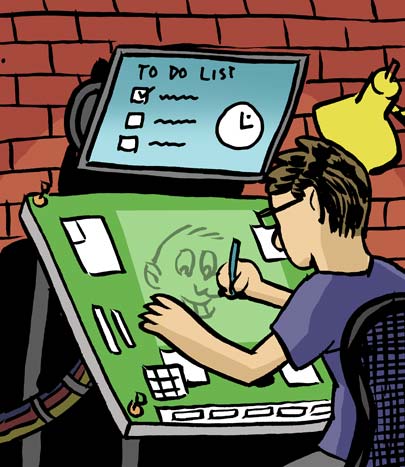
You could use it as a regular desk as well-- it would keep your spreadsheets organized, and your desk could be laid out like mine is now ("I think that's in the upper right hand corner, under the tape dispenser") but with the help of a computer processor to keep everything organized behind the scenes.
Again, I know that people would invent it if they could possibly make it work and make it not cost ten million dollars, so don't worry, guys. I'll wait.
This is more about technology than about no one thinking about it, but I wish someone would invent a floppy pressure-sensitive sheet that could roll out on a drafting table and input drawings into a computer. Like the Wacom tablet, it would be a simple way to draw directly into a computer program, and skip the scanning step.
In this case, the tablet would be (obviously) much larger than the 4x6 to 9x12 area that most reasonably-priced tablets offer, and allow the artist to be more expressive with his or her arm movements.
Now, in the wake of the Cintiq tablets (large rotatable monitors that you can draw on with pressure-sensitive pens), there's the thought of making a sheet like the one above that doubles as a monitor as well. I'm sure people would make it if they could-- I can't imagine a graphic artist that wouldn't at least want to check it out.
You could use it as a regular desk as well-- it would keep your spreadsheets organized, and your desk could be laid out like mine is now ("I think that's in the upper right hand corner, under the tape dispenser") but with the help of a computer processor to keep everything organized behind the scenes.
Again, I know that people would invent it if they could possibly make it work and make it not cost ten million dollars, so don't worry, guys. I'll wait.
Wednesday, March 07, 2007
I Wish Someone Would Invent: a more "in touch" iPod
** UPDATE **
3/13/07: MindHacks.com has a write-up on a commercial biosignal reader from g.MOBIlab. Now all someone has to do is make it play music!
Have you ever thought about an invention that maybe YOU can't make, but it sure would be nice if someone else did?
People have made a big fuss over how their iPods, when on shuffle mode, can play exactly the right song for the moment. This is merely coincidence, of course, and for every Coldplay song you hear right as you are looking at a photo of an old girlfriend, there are thirty Aerosmith songs that play while you think about the grocery list.
But why leave it up to chance? Technology is currently available that can tell what our bodies are thinking. Maybe this technology can't tell exactly which ex-girlfriend is on our mind, but it can at least detect when we're sad and mopey. If someone could just hook these gadgets up to an iPod you'd have a pretty sophisticated little jukebox, able to play just the right song for just the right moment ... every time.

With a little computer programming on the front-end, this smart iPod can read your matrix of body cues and pick the right song. For example:
HIGH heart rate + HIGH cortisol =
I'm being chased by a tiger and I want to stop believing.
inTouch iPod recommends: "Don't Stop Believin'" by Journey
HIGH heart rate + HIGH dopamine =
My significant other and I are "getting busy."
inTouch iPod recommends: "I'm Qualified to Satisfy You" by Barry White
LOW heart rate + HIGH dopamine =
I'm sitting on a beach and someone's feeding me grapes.
inTouch iPod recommends: "Good for Me" by Amy Grant
HIGH heart rate + HIGH cortisol + HIGH GSR =
The boss I hate found out I keyed his Hummer.
inTouch iPod recommends: pretty much anything by Gwar
So, you want to invent it? Already know about something just like it? Got a reason why it would never work? Got some suggestions? Got your own "I Wish Someone Would Invent..."? See you in the comments!
Wednesday, February 28, 2007
I Wish Someone Would Invent: A Decent E-Economy
Have you ever thought about an invention that maybe YOU can't make, but it sure would be nice if someone else did?
No, I didn't stutter, I wish someone would invent a decent e-economy. That is, a way to buy and sell information on the internet that doesn't involve any physical media for a decent price. It's not too bad at the moment. iTunes is as good a way of buying music as any, I guess. It's better for TV shows and movies. I mean, a 48-minute TV show costs $1.99. A 3-minute song costs $.99. Come on! I don't blame Apple-- I know that the music industry has given them weird mandates that they can't really get around at the moment. But the problem with the e-economy as it exists now is that things cost way too much considering how little things cost to distribute and package as opposed to their real-world counterparts. But more to the point, it's too expensive considering how much people want to pay.
We've gotten past all serious talk of micropayments, apparently, especially with Bitpass going under. Bitpass was the first real payment system that allowed vendors to charge small amounts-- as small as a dime-- and they sold Scott McCloud's The Right Number for a quarter per chapter. The Right Number had chapters of about, say, 100 panels each: approximately what you'd have in a regular comic. I jumped at that because I'd been waiting for more McCloud stuff, and I was eager to see his philosophy jump to the mainstream-- the philosophy that large amounts of information should cost small amounts of money. But my thought was that it was a little expensive. It sounds strange to say, since obviously 25 cents is a very small amount of money, but really, 100 panels of free comics online is not exactly a rarity. Far Arden, just to choose an example. So I got it, and it was good (so far-- there's a third chapter that hasn't been done yet), but nothing about the transaction struck me as anything other than proof of concept.
I had some extra money on my BitPass account after that purchase, so I looked around for some other vendors that accepted it. One that interested me was called Dime Novels. A novel for a dime? Wonderful! I'll take it! But the thing was-- they weren't novels. They weren't even novellas. They were about ten pages long. With all the free stuff online and all the great content that people are putting up just for the heck of it, these were a total ripoff. If someone put up a hundred-page novel and charged a quarter for it, I'd get it just to see what it was about. I might not even read the whole thing if it wasn't that great, but I'd never feel like I'd wasted my money. The problem with these products is basically that they failed the sniff test. Does something seem like a great deal? Then people will buy it. Does it seem like it's barely worth it? They won't. 25 cents for a Scott McCloud comic is worth doing once or twice, but I'd start to feel like I was just throwing money away after a half-dozen, even if it wasn't that much money.
A lot of the talk about micropayments was about things like charging a tenth of a cent for a daily comic strip, but to me, that sort of thing just sounded like it would make a good portion of the web a giant pain in the neck. I liked the idea of charging a quarter for a LOT of content, rather than an infinitesimal amount of money for five seconds of entertainment.
Some people bristle at the idea of paying anything for content on the web, and I certainly understand that. There is the feeling that nothing is free anymore, and that browsing anything is a commitment. But I think that if vendors understand that they are competing with huge amounts of quality free material, they would quickly price themselves at a reasonable rate. Little things, like daily strips, would not last long as a paid commodity. But five years of that comic strip in a convenient file format for a quarter sounds like a pretty good deal. The money spent would simply be a small fee for not having to search the whole internet with a peer to peer client.
There are a lot of things to be had online that are not 100% legit that, if they were packaged inexpensively, and I mean REALLY INEXPENSIVELY, could be sold by the creators and copyright holders. One hundred issues of old X-Men comics in pdf format? One dollar. Fifty old-school arcade game ROMs? Five cents. All the Philip Marlowe radio dramas? Buck fifty. A Doc Savage novel? A dime.
It would take some experimenting to find that sweet spot where you're not just giving it away, and still attracting customers, and one might have to find some solutions for bandwidth (like BitTorrent), but isn't that the purpose of an economy? If those things are so readily available for so little money, who (in large numbers) would look for them illegally, except out of sheer cussedness? And (particularly in the examples I've given) if the material is old and out of print, there is little to keep publishers from putting it out there. In most cases they're not making money off it anyway.
Online payment systems, like PayPal, shouldn't have any barriers to transferring small amounts of money from one PayPal account to another-- it's just moving bits-- and charging a small percentage of the price as a transaction fee.
I mean, think about it. What are some big things you'd pay a dollar for?
Scott McCloud's micropayment comic and micropayment essay
Sean Barrett's "upay" response
No, I didn't stutter, I wish someone would invent a decent e-economy. That is, a way to buy and sell information on the internet that doesn't involve any physical media for a decent price. It's not too bad at the moment. iTunes is as good a way of buying music as any, I guess. It's better for TV shows and movies. I mean, a 48-minute TV show costs $1.99. A 3-minute song costs $.99. Come on! I don't blame Apple-- I know that the music industry has given them weird mandates that they can't really get around at the moment. But the problem with the e-economy as it exists now is that things cost way too much considering how little things cost to distribute and package as opposed to their real-world counterparts. But more to the point, it's too expensive considering how much people want to pay.
We've gotten past all serious talk of micropayments, apparently, especially with Bitpass going under. Bitpass was the first real payment system that allowed vendors to charge small amounts-- as small as a dime-- and they sold Scott McCloud's The Right Number for a quarter per chapter. The Right Number had chapters of about, say, 100 panels each: approximately what you'd have in a regular comic. I jumped at that because I'd been waiting for more McCloud stuff, and I was eager to see his philosophy jump to the mainstream-- the philosophy that large amounts of information should cost small amounts of money. But my thought was that it was a little expensive. It sounds strange to say, since obviously 25 cents is a very small amount of money, but really, 100 panels of free comics online is not exactly a rarity. Far Arden, just to choose an example. So I got it, and it was good (so far-- there's a third chapter that hasn't been done yet), but nothing about the transaction struck me as anything other than proof of concept.
I had some extra money on my BitPass account after that purchase, so I looked around for some other vendors that accepted it. One that interested me was called Dime Novels. A novel for a dime? Wonderful! I'll take it! But the thing was-- they weren't novels. They weren't even novellas. They were about ten pages long. With all the free stuff online and all the great content that people are putting up just for the heck of it, these were a total ripoff. If someone put up a hundred-page novel and charged a quarter for it, I'd get it just to see what it was about. I might not even read the whole thing if it wasn't that great, but I'd never feel like I'd wasted my money. The problem with these products is basically that they failed the sniff test. Does something seem like a great deal? Then people will buy it. Does it seem like it's barely worth it? They won't. 25 cents for a Scott McCloud comic is worth doing once or twice, but I'd start to feel like I was just throwing money away after a half-dozen, even if it wasn't that much money.
A lot of the talk about micropayments was about things like charging a tenth of a cent for a daily comic strip, but to me, that sort of thing just sounded like it would make a good portion of the web a giant pain in the neck. I liked the idea of charging a quarter for a LOT of content, rather than an infinitesimal amount of money for five seconds of entertainment.
Some people bristle at the idea of paying anything for content on the web, and I certainly understand that. There is the feeling that nothing is free anymore, and that browsing anything is a commitment. But I think that if vendors understand that they are competing with huge amounts of quality free material, they would quickly price themselves at a reasonable rate. Little things, like daily strips, would not last long as a paid commodity. But five years of that comic strip in a convenient file format for a quarter sounds like a pretty good deal. The money spent would simply be a small fee for not having to search the whole internet with a peer to peer client.
There are a lot of things to be had online that are not 100% legit that, if they were packaged inexpensively, and I mean REALLY INEXPENSIVELY, could be sold by the creators and copyright holders. One hundred issues of old X-Men comics in pdf format? One dollar. Fifty old-school arcade game ROMs? Five cents. All the Philip Marlowe radio dramas? Buck fifty. A Doc Savage novel? A dime.
It would take some experimenting to find that sweet spot where you're not just giving it away, and still attracting customers, and one might have to find some solutions for bandwidth (like BitTorrent), but isn't that the purpose of an economy? If those things are so readily available for so little money, who (in large numbers) would look for them illegally, except out of sheer cussedness? And (particularly in the examples I've given) if the material is old and out of print, there is little to keep publishers from putting it out there. In most cases they're not making money off it anyway.
Online payment systems, like PayPal, shouldn't have any barriers to transferring small amounts of money from one PayPal account to another-- it's just moving bits-- and charging a small percentage of the price as a transaction fee.
I mean, think about it. What are some big things you'd pay a dollar for?
Scott McCloud's micropayment comic and micropayment essay
Sean Barrett's "upay" response
Wednesday, February 21, 2007
I Wish Someone Would Invent: The HamsterCopter
Have you ever thought about an invention that maybe YOU can't make, but it sure would be nice if someone else did?
For far too long, our furried friends the hamsters have been trapped to the ground -- due to gravity, to be sure, but also due in part to humanity's lack of creativity when designing recreational vehicles for said hamsters. A clear plastic ball that rolls around on the floor? Okay, that was fun for awhile. But if I know hamsters, they want to be soaring with bald eagles, not pushing around dust bunnies.
This is where the HamsterCopter comes in. Strap in your little guy and watch him have the time of his life.

Since hamsters don't have a boredom gene, they can have a great time up there for days. You, however, might start yawning after the first few hours, so here are some games you can play with your pal:
* Dodge-a-Hawk
* Raze the Roof!
* The Eyes Closed Game
* Nose Dive Recovery
* Water Landing
* Spoon and Hamster Race
* How Wide is the Middle of That Tire Swing?
Happy Flying!

So, you want to invent it? Already know about something just like it? Got a reason why it would never work? Got some suggestions? Got your own "I Wish Someone Would Invent..."? See you in the comments!
For far too long, our furried friends the hamsters have been trapped to the ground -- due to gravity, to be sure, but also due in part to humanity's lack of creativity when designing recreational vehicles for said hamsters. A clear plastic ball that rolls around on the floor? Okay, that was fun for awhile. But if I know hamsters, they want to be soaring with bald eagles, not pushing around dust bunnies.
This is where the HamsterCopter comes in. Strap in your little guy and watch him have the time of his life.
Since hamsters don't have a boredom gene, they can have a great time up there for days. You, however, might start yawning after the first few hours, so here are some games you can play with your pal:
* Dodge-a-Hawk
* Raze the Roof!
* The Eyes Closed Game
* Nose Dive Recovery
* Water Landing
* Spoon and Hamster Race
* How Wide is the Middle of That Tire Swing?
So, you want to invent it? Already know about something just like it? Got a reason why it would never work? Got some suggestions? Got your own "I Wish Someone Would Invent..."? See you in the comments!
Wednesday, February 14, 2007
I Wish Someone Would Invent: The Luddite Laptop
Have you ever thought about an invention that maybe YOU can't make, but it sure would be nice if someone else did?
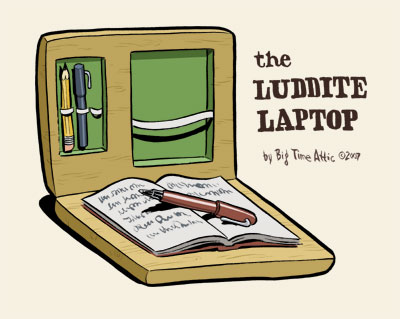
Yep, this is exactly what it looks like. Two slabs of highly polished solid maple hinged together. Two insets dug out of the top to store a notebook and writing utensils. I doubt I'd use something like this, but I would have killed for it in high school, when writing poetry and short stories was an act of rebellion.
Check out these sweet features:
So, you want to invent it? Already know about something just like it? Got a reason why it would never work? Got some suggestions? Got your own "I Wish Someone Would Invent..."? See you in the comments!
Yep, this is exactly what it looks like. Two slabs of highly polished solid maple hinged together. Two insets dug out of the top to store a notebook and writing utensils. I doubt I'd use something like this, but I would have killed for it in high school, when writing poetry and short stories was an act of rebellion.
Check out these sweet features:
- The heavy bottom slab is a great board for any purpose. You can't gut a fish on an electric laptop!
- The insets are lined with the same high quality green felt used to cover pool tables.
- Bottom-heavy so the thing doesn't tip over.
- Elastic straps to keep your stuff in. The only thing spilling out of this laptop are your ideas!
- Unlike the MacBook Pro, the Luddite Laptop won't burn your thighs .. unless it catches on fire!
- Like Dell laptops, the Luddite Laptop can easily catch on fire.
- Floats!
So, you want to invent it? Already know about something just like it? Got a reason why it would never work? Got some suggestions? Got your own "I Wish Someone Would Invent..."? See you in the comments!
Wednesday, February 07, 2007
I Wish Someone Would Invent: Detective Comics Magazine
Have you ever thought about an invention that maybe YOU can't make, but it sure would be nice if someone else did?
I'm going to direct this at DC Comics (Detective Comics Comics, don't you know) since it's the example I'm using, but I just wish this kind of thing existed, by anyone. In America, anyway.
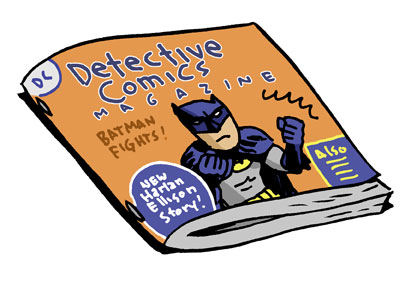
I wish DC Comics would invent Detective Comics Magazine. Right now, there are something like 4 or 5 regular Batman comics. If you're into Batman, you're probably buying them. I wish they would put those regular Batman stories all together in a big 150+ page monthly magazine, add some short backup stories by excellent, but slow or unreliable, artists, possibly a prose detective story, maybe a folded poster, a reprint of a classic Batman story, an out-of-continuity tale, and so on. And you know what? For all I care, you can cram it full of ads, too! Put enough in there that I can pay maybe $6.00 for 150 pages of content, and I'll read all the ads you want me to.
I'm not caught up on what Batman is up to in comics these days, but I would pick up something that would give me a good hour of reading on the bus, even if every story wasn't my cup of tea. It would also give the editors the ability to try out new artists or stories without having to hope that those stories stand on their own right from the get-go. I also like the idea that having prose authors take a shot at a Batman story could be a little more casual. The magazine's got the space. They don't have to make a whole book out of it, just a couple-page story.
I think they could do the same thing with Action Comics Magazine (Superman and friends), Vertigo Comics Magazine (Horror and Crime), Jonni DC Comics Magazine (for kids, all the Adventures-style and Cartoon Network comics), and so on. Then instead of building up readership on all titles, and struggling all the way, they could treat every storyline as a feature, and swap out unpopular features with newer, promising ones, all without the trauma of cancelling or starting new titles.
It also allows a single magazine to gain a following. If an extraordinarily popular feature was in there for a time, the magazine retains that cool factor even when that feature is gone. The readership also becomes more aware of the editor of the book. If a magazine has consistently engaging and well-drawn features month after month, the readers start noticing that that editor is really on the ball and look to him or her to deliver cool stuff in all their projects.
It's the way that almost all Japanese comics are serialized-- the stability of a constant monthly book with high circulation allows a single story to run for dozens of years and thousands of pages, keeping the quality consistent and the flow of the story engaging.
So, you want to invent it? Already know about something just like it? Got a reason why it would never work? Got some suggestions? Got your own "I Wish Someone Would Invent..."? See you in the comments!
I'm going to direct this at DC Comics (Detective Comics Comics, don't you know) since it's the example I'm using, but I just wish this kind of thing existed, by anyone. In America, anyway.
I wish DC Comics would invent Detective Comics Magazine. Right now, there are something like 4 or 5 regular Batman comics. If you're into Batman, you're probably buying them. I wish they would put those regular Batman stories all together in a big 150+ page monthly magazine, add some short backup stories by excellent, but slow or unreliable, artists, possibly a prose detective story, maybe a folded poster, a reprint of a classic Batman story, an out-of-continuity tale, and so on. And you know what? For all I care, you can cram it full of ads, too! Put enough in there that I can pay maybe $6.00 for 150 pages of content, and I'll read all the ads you want me to.
I'm not caught up on what Batman is up to in comics these days, but I would pick up something that would give me a good hour of reading on the bus, even if every story wasn't my cup of tea. It would also give the editors the ability to try out new artists or stories without having to hope that those stories stand on their own right from the get-go. I also like the idea that having prose authors take a shot at a Batman story could be a little more casual. The magazine's got the space. They don't have to make a whole book out of it, just a couple-page story.
I think they could do the same thing with Action Comics Magazine (Superman and friends), Vertigo Comics Magazine (Horror and Crime), Jonni DC Comics Magazine (for kids, all the Adventures-style and Cartoon Network comics), and so on. Then instead of building up readership on all titles, and struggling all the way, they could treat every storyline as a feature, and swap out unpopular features with newer, promising ones, all without the trauma of cancelling or starting new titles.
It also allows a single magazine to gain a following. If an extraordinarily popular feature was in there for a time, the magazine retains that cool factor even when that feature is gone. The readership also becomes more aware of the editor of the book. If a magazine has consistently engaging and well-drawn features month after month, the readers start noticing that that editor is really on the ball and look to him or her to deliver cool stuff in all their projects.
It's the way that almost all Japanese comics are serialized-- the stability of a constant monthly book with high circulation allows a single story to run for dozens of years and thousands of pages, keeping the quality consistent and the flow of the story engaging.
So, you want to invent it? Already know about something just like it? Got a reason why it would never work? Got some suggestions? Got your own "I Wish Someone Would Invent..."? See you in the comments!
Wednesday, January 31, 2007
I Wish Someone Would Invent: The Osmium Rocker
Have you ever thought about an invention that maybe YOU can't make, but it sure would be nice if someone else did?
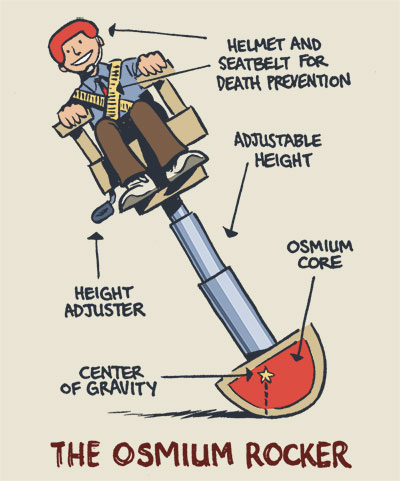
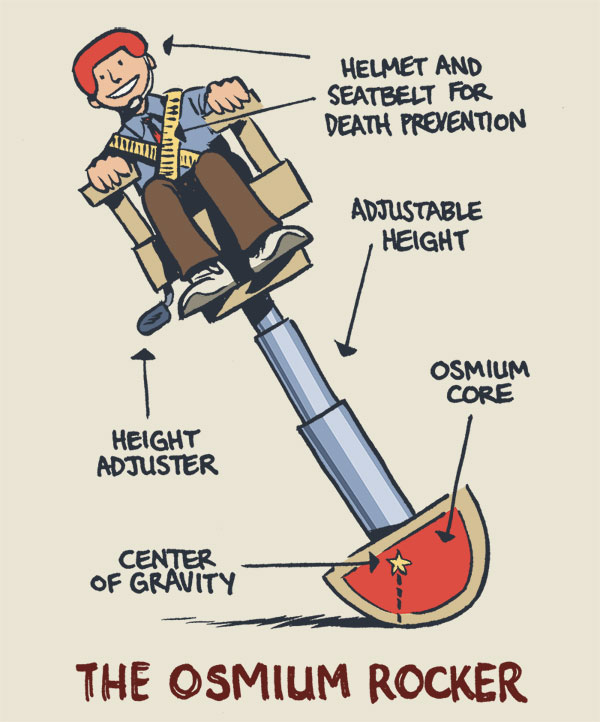
This rocking chair concept is based on the design of inflatable punching toys (are they still around any more?), in that no matter how close to the ground they get, their base is heavy enough to bring it upright again, every time. I think it would be fun to have a rocking chair like this, so that the rider could rock themselves all over the place but never fear falling over. A quick google search informed me that osmium is a pretty heavy material, which is why that forms the core. Experiments would have to determine whether rocks would be sufficient to replace osmium, which costs $400 per troy ounce.
So, you want to invent it? Already know about something just like it? Got a reason why it would never work? Got some suggestions? Got your own "I Wish Someone Would Invent..."? See you in the comments!
This rocking chair concept is based on the design of inflatable punching toys (are they still around any more?), in that no matter how close to the ground they get, their base is heavy enough to bring it upright again, every time. I think it would be fun to have a rocking chair like this, so that the rider could rock themselves all over the place but never fear falling over. A quick google search informed me that osmium is a pretty heavy material, which is why that forms the core. Experiments would have to determine whether rocks would be sufficient to replace osmium, which costs $400 per troy ounce.
So, you want to invent it? Already know about something just like it? Got a reason why it would never work? Got some suggestions? Got your own "I Wish Someone Would Invent..."? See you in the comments!
Wednesday, January 24, 2007
I Wish Someone Would Invent: the HMS Delicious
Have you ever thought about an invention that maybe YOU can't make, but it sure would be nice if someone else did?
I wish someone would invent a clipper ship restaurant for us landlocked folks in Minneapolis. Not a clipper ship THEMED restaurant with anachronistic trinkets on wall, but an honest to goodness clipper ship that was picked up from some under-appreciated coastal maritime museum and dropped in a big Peavy Plaza-style pond in the middle of downtown.
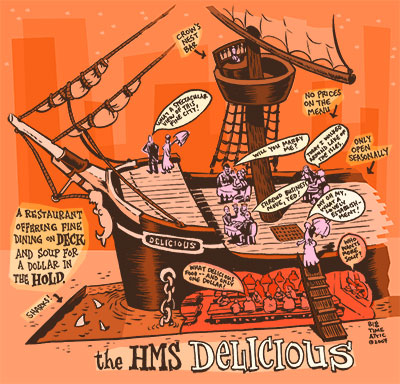
Eating at the HMS Delicious would be a fun experience -- not just because it's a ship, but because instead of pandering to the middle class by offering normal food at decent prices, it would recognize and celebrate America's growing economic rift between the ultra rich and ultra poor. So on the top deck, amidst the bright lights and cool breeze of the city, would be the most expensive restaurant in the city. Imagine the old Aquavit but on a ship. The menu would be whatever's fresh, caught that day and flown in, and there'd probably be only one or two choices daily. You'd have to wear something really expensive and smoking a pipe or cigar would be highly encouraged. No beer on the top deck, just wine for the ladies and scotch for the gents. Blue label if you're feeling frisky and Sheep Dip if you just want to relax.
But below, in the hold, you'd find the completely opposite experience. There you could find rows and rows of wooden tables and one small kitchen serving soup and bread. A bowl for a buck. It wouldn't literally be a soup kitchen, though. You wouldn't have to be in rough shape to be served. It's for the budget-conscious Minneapolitan who can't afford Panera every day and who doesn't want to fill up on Taco Bell either. The hold would be a frank, no-nonsense place where you can get your fill and then get back to work.
Man, if someone invented the HMS Delicious I would eat there every day.
So, you want to invent it? Already know about something just like it? Got a reason why it would never work? Got some suggestions? Got your own "I Wish Someone Would Invent..."? See you in the comments!
I wish someone would invent a clipper ship restaurant for us landlocked folks in Minneapolis. Not a clipper ship THEMED restaurant with anachronistic trinkets on wall, but an honest to goodness clipper ship that was picked up from some under-appreciated coastal maritime museum and dropped in a big Peavy Plaza-style pond in the middle of downtown.
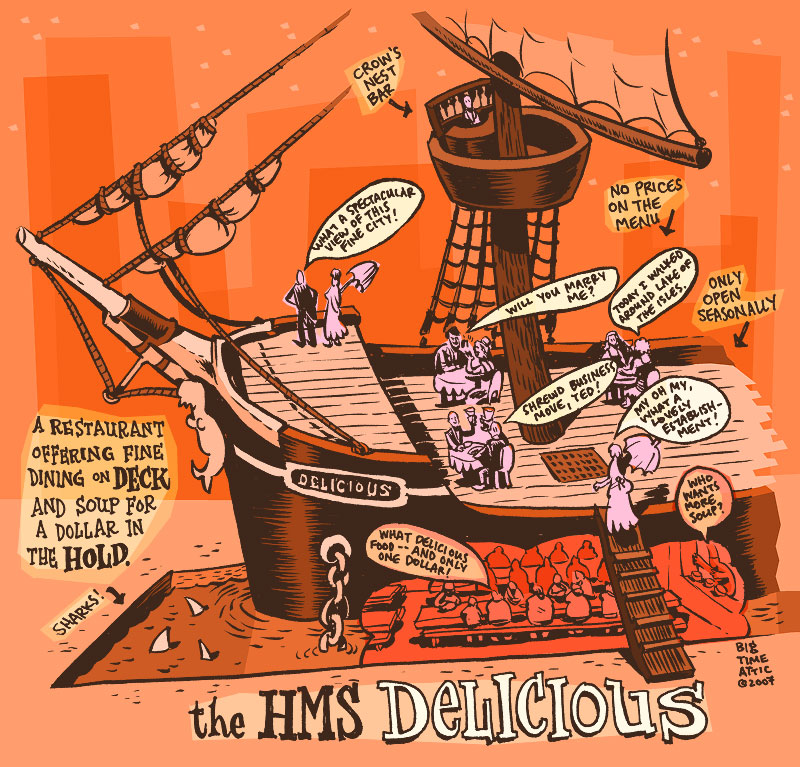
Eating at the HMS Delicious would be a fun experience -- not just because it's a ship, but because instead of pandering to the middle class by offering normal food at decent prices, it would recognize and celebrate America's growing economic rift between the ultra rich and ultra poor. So on the top deck, amidst the bright lights and cool breeze of the city, would be the most expensive restaurant in the city. Imagine the old Aquavit but on a ship. The menu would be whatever's fresh, caught that day and flown in, and there'd probably be only one or two choices daily. You'd have to wear something really expensive and smoking a pipe or cigar would be highly encouraged. No beer on the top deck, just wine for the ladies and scotch for the gents. Blue label if you're feeling frisky and Sheep Dip if you just want to relax.
But below, in the hold, you'd find the completely opposite experience. There you could find rows and rows of wooden tables and one small kitchen serving soup and bread. A bowl for a buck. It wouldn't literally be a soup kitchen, though. You wouldn't have to be in rough shape to be served. It's for the budget-conscious Minneapolitan who can't afford Panera every day and who doesn't want to fill up on Taco Bell either. The hold would be a frank, no-nonsense place where you can get your fill and then get back to work.
Man, if someone invented the HMS Delicious I would eat there every day.
So, you want to invent it? Already know about something just like it? Got a reason why it would never work? Got some suggestions? Got your own "I Wish Someone Would Invent..."? See you in the comments!
Wednesday, January 17, 2007
I Wish Someone Would Invent: An E-Reader
Have you ever thought about an invention that maybe YOU can't make, but it sure would be nice if someone else did?
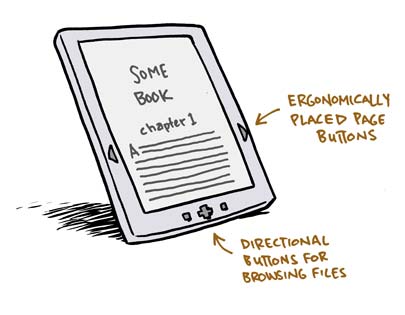
I wish someone would invent an inexpensive e-reader that could display high resolution static images with minimal battery power. It would be approximately the size of a letter-sized notebook, come with a cover that can be closed, and have a slot for Compact Flash cards or some other removable storage device. It would be able to display any kind of picture or document file, such as .txt, .doc, .rtf, .pdf, .jpg, and .gif. So any novel you have as a text file, Word file, or PDF could easily be read, as well as any comics or other visual storytelling. The screen would be bright white so as to easily be read in the same situations a book or magazine might be. A screen of "e-paper" would do this nicely.
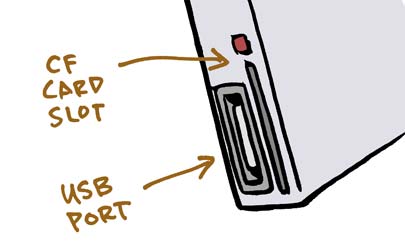
The reader would come with a small CF card, like digital cameras do, which could be upgraded to any size card someone wants to buy, depending on how much information they want to carry around. The device would also have a USB port, so that information could be easily transferred to it. The reader would come with a very rudimentary word processing program, like WordPad or TextEdit, so if someone chose to write something, they could just plug in any USB keyboard to the e-reader, and type to their hearts' content.

One more thing that might add value would be to put a cellular modem in the reader (or make one that can be plugged in) so that the reader could download content from newspapers or magazines and enjoy up-to-the-minute info.
The device should be cheap, under $40 US if possible, and light. I mean, it would be my one book I'd take to a desert island; I want it to be pretty portable.
So, you want to invent it? Already know about something just like it? Got a reason why it would never work? Got some suggestions? Got your own "I Wish Someone Would Invent..."? See you in the comments!
UPDATE: INVENTED?
Here is a forthcoming reader from Sony (thank you Kevin) that is basically along the same lines. No price is listed yet, but the simple design indicates that it could well be in the <$100 range. Its small screen size looks like there will be no comics to be read on there, and my cynical side says that because it's from Sony, there will probably be a very limited number of (proprietary) file formats which it will be willing to read. Time will tell; keep those fingers crossed!
UPDATE NUMBER 2: INVENTED?
Amazon.com's Jeff Bezos talks in this Newsweek article about the "Kindle", a new e-reader that will be coming out this year (2007) that uses e-ink and all that stuff. It will be more expensive than one would hope at $399, but it has the ability to download (almost) any book at (almost) any time via an always-on cellular network. Files are proprietary from what I understand, although I can't imagine that it couldn't read something like a Word document or a Rich Text File. There's a lot of jibberjabber in this article about changing the way people read, write, comment, and live their lives, but there's also a lot of what seems to be more sensible talk about how the feel of it will be very familiar to book readers, which I think is a real necessity when you want a lot of adherents.
UPDATE NUMBER 3: INVENTED?
Another reader hits the market soon: a reader from a company called Plastic Logic. Here at Gizmodo, they say:
Here is what the clunky Amazon Kindle should have been since the beginning: a simple, ultra-sleek full-page 8.5-inch by 11-inch electronic book and newspaper reader with a flexible plastic touchscreen, Wi-Fi connectivity, and the ability to read regular Office documents without conversion of any kind.
Looking good! It could read comics!
I wish someone would invent an inexpensive e-reader that could display high resolution static images with minimal battery power. It would be approximately the size of a letter-sized notebook, come with a cover that can be closed, and have a slot for Compact Flash cards or some other removable storage device. It would be able to display any kind of picture or document file, such as .txt, .doc, .rtf, .pdf, .jpg, and .gif. So any novel you have as a text file, Word file, or PDF could easily be read, as well as any comics or other visual storytelling. The screen would be bright white so as to easily be read in the same situations a book or magazine might be. A screen of "e-paper" would do this nicely.
The reader would come with a small CF card, like digital cameras do, which could be upgraded to any size card someone wants to buy, depending on how much information they want to carry around. The device would also have a USB port, so that information could be easily transferred to it. The reader would come with a very rudimentary word processing program, like WordPad or TextEdit, so if someone chose to write something, they could just plug in any USB keyboard to the e-reader, and type to their hearts' content.
One more thing that might add value would be to put a cellular modem in the reader (or make one that can be plugged in) so that the reader could download content from newspapers or magazines and enjoy up-to-the-minute info.
The device should be cheap, under $40 US if possible, and light. I mean, it would be my one book I'd take to a desert island; I want it to be pretty portable.
So, you want to invent it? Already know about something just like it? Got a reason why it would never work? Got some suggestions? Got your own "I Wish Someone Would Invent..."? See you in the comments!
UPDATE: INVENTED?
Here is a forthcoming reader from Sony (thank you Kevin) that is basically along the same lines. No price is listed yet, but the simple design indicates that it could well be in the <$100 range. Its small screen size looks like there will be no comics to be read on there, and my cynical side says that because it's from Sony, there will probably be a very limited number of (proprietary) file formats which it will be willing to read. Time will tell; keep those fingers crossed!
UPDATE NUMBER 2: INVENTED?
Amazon.com's Jeff Bezos talks in this Newsweek article about the "Kindle", a new e-reader that will be coming out this year (2007) that uses e-ink and all that stuff. It will be more expensive than one would hope at $399, but it has the ability to download (almost) any book at (almost) any time via an always-on cellular network. Files are proprietary from what I understand, although I can't imagine that it couldn't read something like a Word document or a Rich Text File. There's a lot of jibberjabber in this article about changing the way people read, write, comment, and live their lives, but there's also a lot of what seems to be more sensible talk about how the feel of it will be very familiar to book readers, which I think is a real necessity when you want a lot of adherents.
UPDATE NUMBER 3: INVENTED?
Another reader hits the market soon: a reader from a company called Plastic Logic. Here at Gizmodo, they say:
Here is what the clunky Amazon Kindle should have been since the beginning: a simple, ultra-sleek full-page 8.5-inch by 11-inch electronic book and newspaper reader with a flexible plastic touchscreen, Wi-Fi connectivity, and the ability to read regular Office documents without conversion of any kind.
Looking good! It could read comics!
Subscribe to:
Posts (Atom)